
Spiral Staircase Designer
3D Preview
Designing a spiral staircase can feel complex—but with the right tool, it becomes fast, accurate, and even enjoyable. This spiral staircase calculator helps you determine step height, tread depth, rotation angle, and total dimensions in seconds, while also guiding you toward a safe and buildable design.
Whether you're a DIY homeowner, contractor, or designer, this tool goes beyond basic calculations and acts as a complete staircase planning system.
Spiral Staircase Calculator Tool
Use the calculator above to input your:
- Total height (floor-to-floor)
- Staircase diameter
- Number of steps
- Unit system (mm, cm, inches, feet)
What You Get Instantly
- Step rise (height per step)
- Tread depth at walkline
- Step angle (rotation per step)
- Total rotation (usually 360°)
- Handrail length estimation
- 2D and 3D visualization
Unlike traditional tools, this calculator also provides real-time feedback, helping you avoid unsafe or impractical designs.
Smart Recommendations for Better Stair Design
Most calculators simply output numbers. This tool helps you make decisions.
Recommended Number of Steps
The ideal number of steps depends on total height. A comfortable stair typically has:
- Riser height between 150–200 mm (6–8 inches)
If your riser is too high, the staircase becomes steep and unsafe.
Ideal Spiral/Circular Staircase Diameter
- Minimum: 1200 mm (4 ft) → very tight
- Comfortable: 1500–1800 mm (5–6 ft)
- Luxury: 2000 mm+ (6.5 ft+)
A larger diameter significantly improves walking comfort and safety.
Comfortable Tread Depth
The tread depth at the walkline should be:
- At least 200 mm (8 inches)
This ensures proper footing and prevents slipping.
Safety and Code Compliance
Safety is critical when designing spiral stairs.
Maximum Riser Height
Most building codes recommend:
- Maximum riser: 200 mm (7.75–9 inches)
Minimum Tread Depth
At the walkline:
- Minimum: 190–200 mm
Headroom Clearance
Ensure at least:
- 2000 mm (6 ft 6 in) vertical clearance
If you want to verify general construction safety principles, you can review detailed structural guidelines from organizations like the American Society of Civil Engineers.
Builder Outputs (What Makes This Tool Better)
This is where most competitors fail.
Material Estimation
You can derive:
- Number of treads
- Central column height
- Handrail length
Cutting Measurements
Each step is defined by:
- Rotation angle
- Radial length
- Step thickness
Handrail Length Calculation
The handrail follows a helical path, calculated using:
- Stair circumference
- Total height
For more complex curved structures, engineers often reference geometric modeling approaches similar to those used in computational geometry.
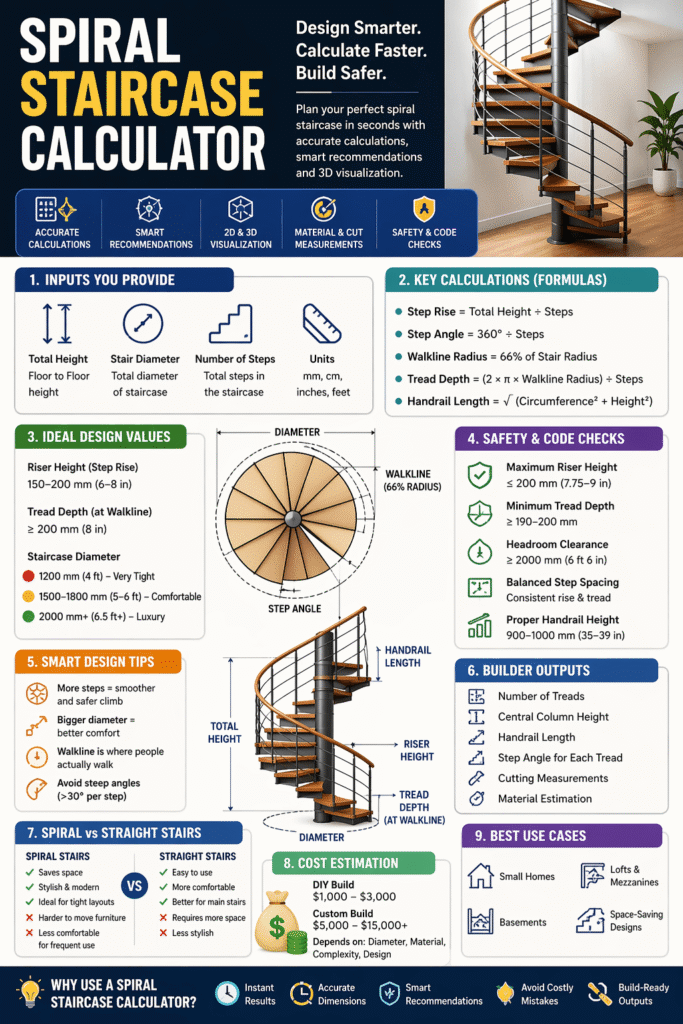
How to Calculate a Spiral Staircase (Step-by-Step)
Understanding the math gives you full control over your design.
1. Calculate Step Rise
Step Rise = Total Height ÷ Number of Steps
2. Calculate Step Angle
Step Angle = 360° ÷ Number of Steps
3. Calculate Walkline Circumference
The walkline is typically:
- 2/3 of the radius from the center
4. Calculate Tread Depth
Tread Depth = (2 × π × Walkline Radius) ÷ Steps
Understanding Spiral Staircase Dimensions
What Is Staircase Diameter?
The full width of the staircase, including:
- Central column
- Walking space
Inner vs Outer Radius
- Inner radius: near the central column (tightest area)
- Outer radius: widest walking area
What Is the Walkline?
The walkline represents where people naturally step.
It’s usually located about:
- 300 mm (12 inches) from the inner edge
This is the most important measurement for comfort.
Choosing the Right Spiral Staircase Size
Best Size for Small Spaces
- 1200–1400 mm diameter
- Steeper, but space-saving
Standard Residential Size
- 1500–1800 mm
- Balanced comfort and space
Large / Premium Designs
- 2000 mm+
- Easy to use and visually impressive
When planning space layouts, tools like SketchUp can help visualize how your staircase fits into a room.
Spiral Staircase vs Regular Stairs
Advantages
- Saves space
- Stylish design
- Ideal for tight layouts
Disadvantages
- Harder to move furniture
- Less comfortable for frequent use
- Not always code-compliant for main stairs
Spiral Staircase Cost Estimation
Costs vary based on:
- Diameter
- Material (wood, steel, concrete)
- Complexity
Typical Cost Range
- DIY: $1,000 – $3,000
- Custom build: $5,000 – $15,000+
FAQs
How many steps are in a spiral staircase?
Usually between 12–20 steps, depending on height.
What is the standard diameter?
Most homes use 1500–1800 mm (5–6 ft).
What is the minimum tread depth?
At least 190–200 mm at the walkline.
Is a spiral staircase safe?
Yes—if designed with proper:
- riser height
- tread depth
- headroom
Can I build a spiral staircase myself?
Yes, but accuracy is critical. A calculator like this helps ensure:
- correct geometry
- safe dimensions
Final Thoughts
A spiral staircase isn’t just a design feature—it’s a structural system that must balance:
- geometry
- safety
- usability
Most tools stop at calculations.
This calculator goes further by helping you:
- visualize your design
- validate safety
- prepare for construction