Curved Staircase Calculator
A curved staircase calculator is a professional-grade design tool used by architects, engineers, and builders to accurately calculate the geometry of curved staircases. Because curved stairs involve complex circular motion, radius-based layouts, and varying tread depths, even small miscalculations can lead to unsafe or impractical designs.
This guide explains how a curved staircase calculator works, why it is essential in modern construction, and how professionals use it to ensure accuracy, safety, and aesthetic quality in staircase design.
What is a Curved Staircase?
A curved staircase is a staircase that follows a smooth arc rather than straight lines or sharp directional turns. It is commonly used in:
- Luxury residential homes
- Hotel lobbies and commercial entrances
- Modern office interiors
- Architectural focal point designs
Unlike spiral staircases that rotate around a central column, curved staircases have a larger turning radius, offering a more open, comfortable walking experience.
This design flexibility makes them visually appealing but also mathematically complex—this is where a curved staircase calculator becomes essential.
Why a Curved Staircase Calculator is Important
Designing curved stairs manually requires advanced geometry and precise measurements. Without proper calculation, issues such as uneven steps, poor alignment, or unsafe tread depth may occur.
A curved staircase calculator helps solve:
- Arc length distribution
- Radius-based step alignment
- Inner vs outer tread variation
- Step angle segmentation
- Total step optimization
Key Benefits:
- Eliminates human calculation errors
- Improves construction accuracy
- Reduces material waste
- Saves design time
- Enhances structural safety
In professional architecture workflows, accuracy is not optional—it is a safety requirement.
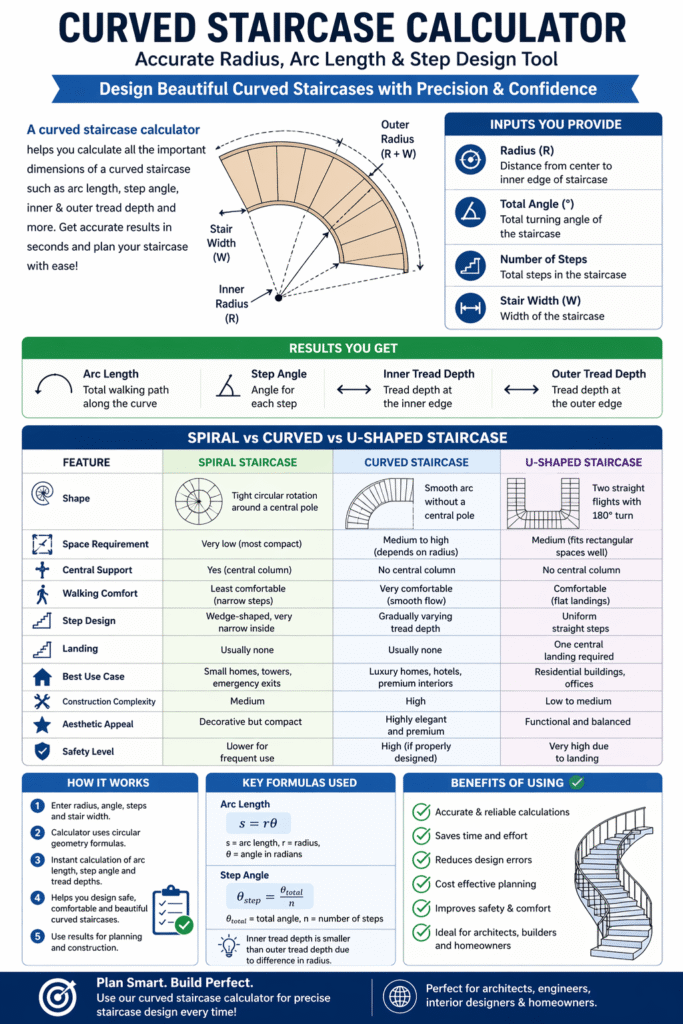
Inputs Required in a Curved Staircase Calculator
To generate accurate results, the calculator typically requires:
1. Radius
The distance from the center point of the curve to the inner edge of the staircase.
2. Total Angle
The total turning angle of the staircase (commonly 90°, 180°, or 270°).
3. Number of Steps
Determines how the curve is divided evenly.
4. Stair Width
Defines usable walking space between inner and outer edges.
These inputs allow the system to calculate precise geometric outputs for construction planning.
How a Curved Staircase Calculator Works
At its core, staircase design is based on circular geometry and trigonometric division.
Arc Length Calculation
s=rθ
Where:
- s = arc length
- r = radius
- θ = angle in radians
This determines the total walking path along the curve.
Step Angle Division
θstep=nθtotal
Where:
- n = number of steps
This ensures equal distribution of steps along the curve for smooth movement and balanced design.
Inner vs Outer Tread Design Consideration
One of the most critical aspects of curved stair design is tread variation.
- Inner edge = shorter walking distance
- Outer edge = longer arc path
A properly designed staircase ensures:
- Comfortable foot placement
- Uniform rise-to-run ratio
- Safe movement across all steps
A curved staircase calculator automatically balances these variations to meet ergonomic and safety standards.
Real-World Use of Curved Staircase Calculations
Professionals use curved staircase calculations in:
- Architectural planning
- Structural engineering layouts
- Interior design visualization
- Construction execution drawings
For example, in luxury villas, curved staircases are often designed as central visual features, requiring precise alignment between aesthetics and structural integrity.
Software & Industry Tools Used in Stair Design
To move from calculation to real-world design, professionals often rely on digital tools:
🔹 CAD-Based Drafting Workflows
Modern architects use CAD tools for precise staircase drawings and construction documentation.
👉 Learn more about professional drafting workflows in CAD environments:
https://www.autodesk.com/solutions/cad-software
🔹 3D Staircase Visualization
3D modeling helps visualize curved stair geometry before construction begins.
👉 Explore staircase modeling and spatial visualization tools:
https://www.sketchup.com/learn
🔹 Architectural Geometry Principles
Understanding geometry is essential for safe and functional staircase design.
👉 Reference architectural and geometric fundamentals:
https://en.wikipedia.org/wiki/Staircase
Example Calculation (Simplified)
Assume:
- Radius = 2000 mm
- Total angle = 180°
- Steps = 14
A curved staircase calculator will:
- Convert angle into radians
- Calculate arc length
- Divide steps evenly
- Generate tread distribution
- Output construction-ready values
This removes manual guesswork and ensures precision in design execution.
Curved vs Spiral Staircases (Quick Comparison)
| Feature | Curved Staircase | Spiral Staircase |
|---|---|---|
| Shape | Smooth arc | Tight circular coil |
| Center support | Not required | Central column required |
| Walking comfort | High | Moderate |
| Space usage | Medium to large | Compact |
| Aesthetic value | Premium architectural feature | Functional compact design |
FAQs
What is a curved staircase calculator used for?
It is used to calculate radius-based geometry, step distribution, and arc length for curved staircases.
Is a curved staircase harder to design than a straight staircase?
Yes, because it involves circular geometry and varying tread lengths.
Can I use this for construction planning?
Yes, professionals use these calculations as a base for CAD drawings and site execution.
Final Thoughts
A curved staircase calculator is an essential tool for architects, builders, engineers, and homeowners who want to design elegant curved staircases with precision. Unlike straight or U-shaped stairs, curved staircases require accurate geometric calculations involving radius, arc length, tread distribution, and step angles. Even a small error can affect comfort, safety, and construction feasibility.
In this detailed guide, we have explored how a curved staircase calculator works, why it is important, and how you can use it to design efficient and visually appealing staircases for residential and commercial projects.