
U Shaped Staircase Calculator
Design accurate and safe stairs with our U shaped staircase calculator. Quickly calculate total rise, run, number of steps, tread depth, and landing dimensions for a perfect 180° turn staircase layout.
For a complete set of tools, explore the full suite here.
🔧 Enter Staircase Dimensions
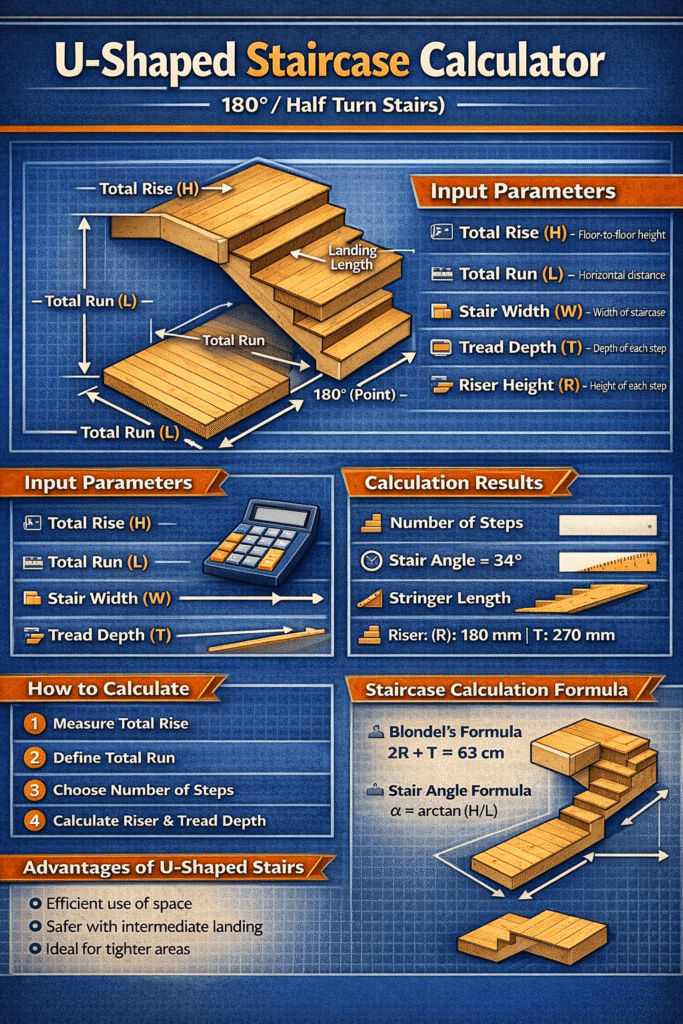
To calculate a U-shaped staircase, input the following values:
- Total Rise (H) – Floor-to-floor height
- Total Run (L) – Horizontal distance covered
- Stair Width (W) – Width of the staircase
- Tread Depth (T) – Depth of each step
- Riser Height (R) – Height of each step
- Landing Length / Winder Turn – Turning section size
📊 Calculation Results
After entering values, the calculator provides:
- Total number of steps
- Stair angle (slope)
- Step dimensions (rise & tread)
- Stringer length
- Landing or turning configuration
🧠 What Is a U Shaped Staircase?
A U-shaped staircase is a stair design that turns 180 degrees, typically consisting of two parallel flights connected by a landing or winder steps. It is commonly used in residential and commercial buildings for efficient space usage and improved safety.
🧮 How to Calculate a U Shaped Staircase
Follow these steps for accurate design:
Step 1: Measure Total Rise
Determine the vertical distance between finished floors.
Step 2: Define Total Run
Measure the horizontal space available.
Step 3: Select Number of Steps
Divide total rise by a comfortable riser height.
Step 4: Calculate Riser Height
Riser height = Total Rise ÷ Number of Steps
Step 5: Calculate Tread Depth
Choose a tread depth that ensures comfort and safety.
Step 6: Design Landing or Winder Turn
Decide between a flat landing or angled winder steps based on space.
📐 Staircase Calculation Formulas
Blondel Formula (Comfort Rule)
2R + T = 63 cm (or 24–25 inches)
Stair Angle Formula
Angle = arctan (Rise / Run)
Step Count Formula
Number of Steps = Total Rise ÷ Riser Height
These formulas ensure the staircase is both safe and comfortable.
📏 Input Parameters Explained
- H (Total Rise): Vertical height between floors
- L (Total Run): Horizontal length of staircase
- W (Width): Staircase width
- T (Tread Depth): Step depth
- R (Riser Height): Step height
- Landing Size: Space for turning
🔄 Types of U Shaped Stairs
U-Shaped with Landing
Includes a flat platform for direction change.
U-Shaped with Winder Steps
Uses angled steps instead of a landing.
Compact U-Shaped Design
Optimized for tight spaces.
🏗️ Design Tips for Better Staircase
- Maintain stair angle between 30°–40°
- Keep riser height between 150–190 mm
- Ensure consistent step dimensions
- Provide adequate headroom and width
For structural planning standards, refer to official building safety frameworks followed in residential staircase design.
✅ Advantages of U Shaped Staircase
- Efficient use of space
- Safer due to intermediate landing
- Suitable for compact layouts
- Improved visual appeal
To understand how ergonomic spacing impacts usability, see real architectural case studies showing efficient space planning in modern homes.
❓ FAQs – U Shaped Staircase Calculator
How many steps are needed?
Depends on total rise and riser height. Most designs use 10–20 steps.
What is the ideal riser height?
Typically between 150 mm and 190 mm.
What is the standard tread depth?
Usually 250 mm to 300 mm.
How much space is required?
Varies, but compact designs can fit within limited floor areas.
Can I use winder steps instead of a landing?
Yes, but they require careful design for safety and comfort.
For deeper mathematical understanding of stair geometry, explore step-by-step breakdown of geometric principles used in real-world construction layouts.
Conclusion
The U shaped staircase calculator is an essential tool for designing safe, efficient, and well-balanced 180° stair layouts without manual guesswork. By accurately calculating total rise, run, number of steps, tread depth, riser height, and landing or winder dimensions, it helps transform complex staircase planning into a simple and structured process.
Whether you are working on a compact residential project or a larger architectural design, using a U shaped staircase calculator ensures that your staircase follows proper geometric proportions, maintains user comfort, and aligns with standard construction principles.
Ultimately, this tool not only saves time but also improves design accuracy, helping you create staircases that are both functional and visually well-balanced for modern spaces.