
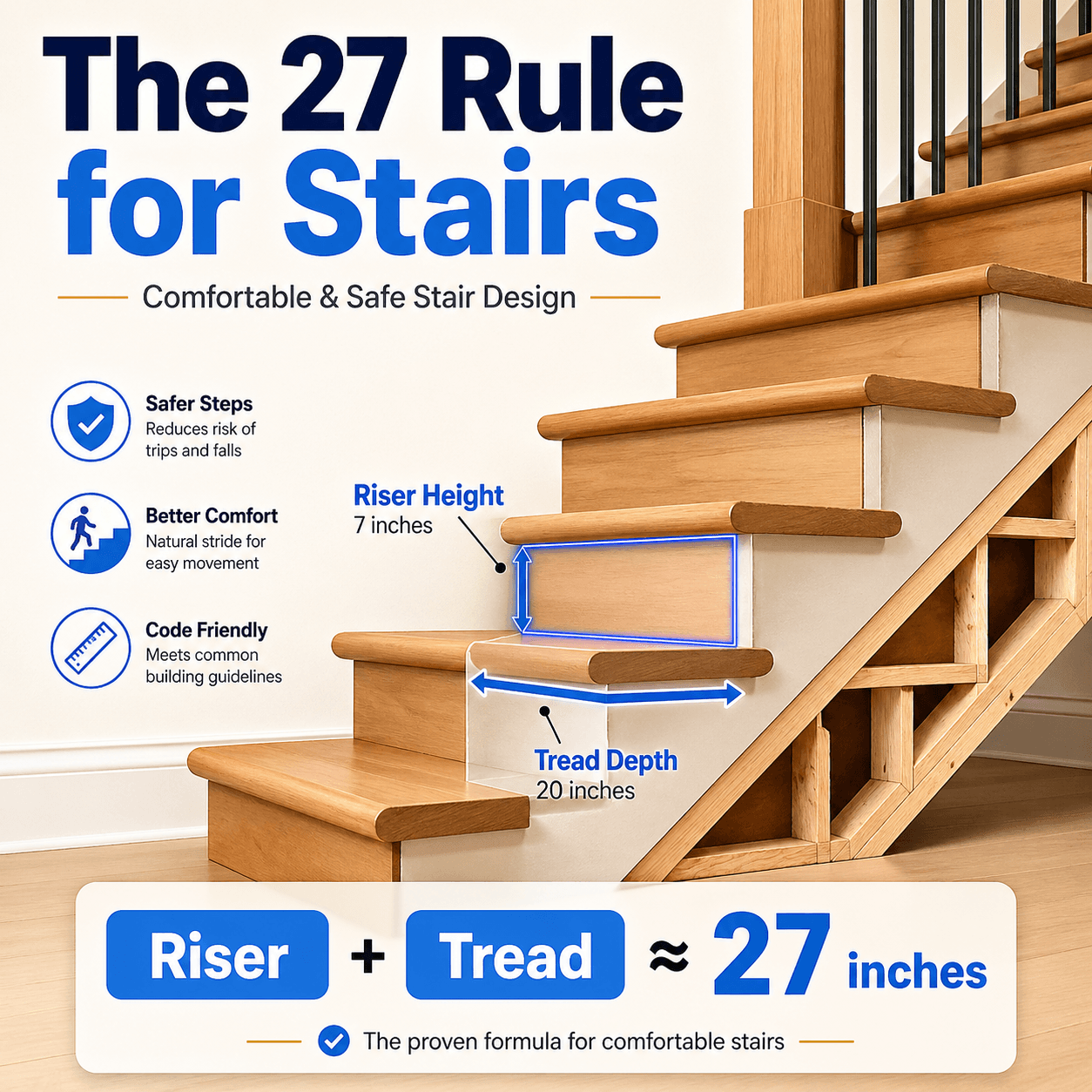
The short answer: The “27 rule for stairs” refers to a comfort formula where 2 × Riser Height + Tread Depth = 24–27 inches. This ensures your staircase matches the natural stride length of most adults. However, the term is also used to describe two other guidelines — the 27-inch minimum tread width rule, and the 27-step maximum flight rule. This article breaks down all three, so you know exactly which one applies to your project.
Why There’s Confusion Around the “27 Rule”
If you’ve searched for the 27 rule for stairs and found different answers on different websites, you’re not imagining it. The phrase “27 rule” floats around stair construction with at least three different meanings, depending on who you ask:
- The 2R + T = 24–27 inch comfort formula (the most common professional interpretation)
- The 27-inch minimum walkable width guideline
- The 27-step maximum rule before a landing is required
None of these are wrong — they’re just different rules that happen to share the same number. Let’s walk through each one clearly.
Version 1: The 2R + T Formula (The “True” 27 Rule)
This is the most widely referenced version among builders, architects, and designers.
What the formula says:
2 × Riser Height + Tread Depth = 24 to 27 inches
Where:
- Riser = the vertical height of each step
- Tread = the horizontal depth of each step (where your foot lands)
Why 24 to 27?
The formula is rooted in human biomechanics. On flat ground, the average adult takes a stride of roughly 24–25 inches. On a staircase, each step requires extra vertical effort, which effectively shortens your comfortable stride. The formula accounts for this by using two risers (the vertical exertion × 2) plus one tread (the horizontal placement) to land within the natural walking range.
When the result falls between 24 and 27 inches, your stairs feel effortless. When it falls below 24, the steps feel too shallow and choppy. Above 27, each step feels like a lunge.
The 2R + T Rule for Stairs
Riser (R): Vertical height of each step
Tread (T): Horizontal depth where your foot lands
Why 24–27?
This formula is based on natural walking movement. On flat ground, the average stride is about 24–25 inches. Stairs require extra effort, so the formula balances vertical and horizontal movement.
Too short
Feels choppy
Comfortable
Natural steps
Too long
Feels like a lunge
Practical Example:
| Riser Height | Tread Depth | 2R + T Result | Comfortable? |
|---|---|---|---|
| 7″ | 11″ | 25″ | ✅ Yes — ideal |
| 7.5″ | 10″ | 25″ | ✅ Yes — good |
| 8″ | 9″ | 25″ | ⚠️ Borderline |
| 6.5″ | 12″ | 25″ | ✅ Yes — gentle slope |
| 8.5″ | 9″ | 26″ | ❌ Too steep |
The sweet spot most builders aim for: a 7-inch riser paired with an 11-inch tread gives you 2(7) + 11 = 25 inches — right in the center of the comfort zone.
Version 2: The Related “17–18 Rule” (Riser + Tread = 17–18)
You’ll often see this paired with the 27 rule, and it’s worth knowing both because they overlap in application.
Riser + Tread = 17 to 18 inches
This is sometimes mistakenly called the “27 rule,” especially on UK and Australian stair forums. The logic is similar — it’s a simplified single-formula check rather than the more precise 2R+T method.
- A 7″ riser + 10″ tread = 17″ ✅
- A 7″ riser + 11″ tread = 18″ ✅ (often considered optimal)
- A 8″ riser + 9″ tread = 17″ ✅ (within range, but steep)
This is where some of the “27 rule” confusion comes from. Informally, some sources compress the two formulas together and reference the upper bound (27) of the 2R+T formula as the defining number.
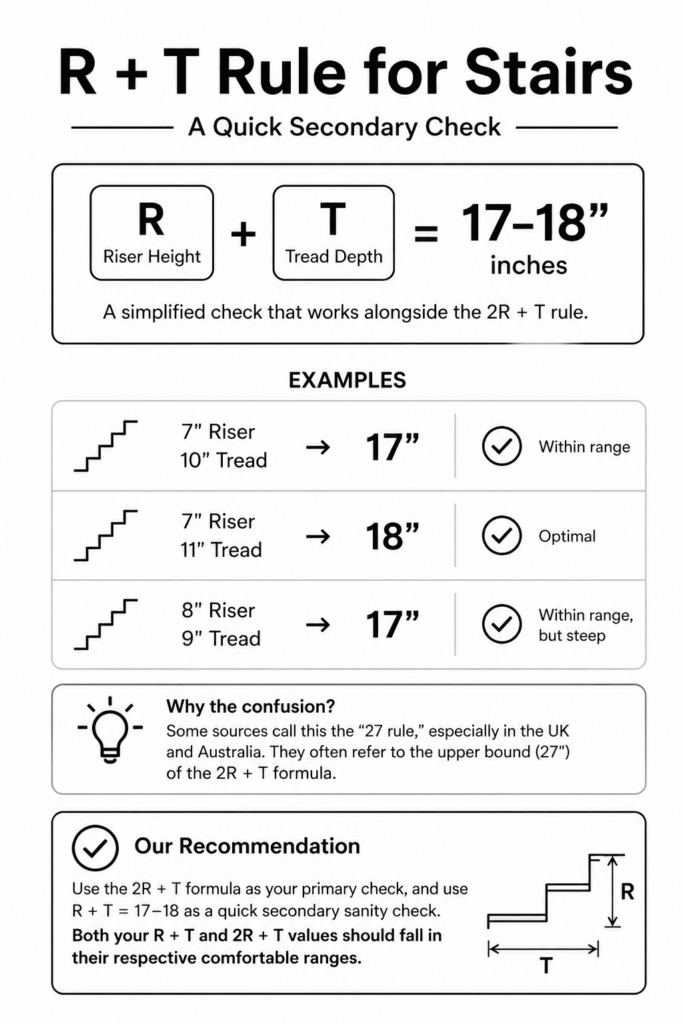
Our recommendation: use the 2R + T formula as your primary check, and use R + T = 17–18 as a quick secondary sanity check. Both your riser + tread AND your 2-riser + tread values should fall in their respective comfortable ranges.
Version 3: The 27-Inch Minimum Width Rule
A completely separate use of “27” in stair design: the minimum clear width of 27 inches between handrails when handrails are installed on both sides.
Where this comes from:
Under the International Residential Code (IRC Section R311.7), residential stairs must have a minimum width of 36 inches. However, handrails are permitted to project up to 4.5 inches on each side. When handrails are installed on both sides:
36″ − 4.5″ − 4.5″ = 27 inches minimum clear width
This is the narrowest a staircase can legally be (with both handrails installed) in most U.S. residential construction. So if someone says “the 27-inch rule for staircases,” they’re likely referring to this code-derived clearance minimum.
Important: This is a minimum code floor, not a comfort target. For comfortable daily use, especially moving furniture or assisting someone, 36–42 inches clear is far more practical.
Version 4: The 27-Step Maximum Rule
This one is the most distinct from the others and applies specifically to flight length.
What it says:
A single flight of stairs should not exceed 27 risers without a landing.
Most building codes — including the IRC — cap the maximum total rise in a single flight at 147 inches (12 feet 3 inches). At a standard 7″ riser, that works out to approximately 21 risers before a landing is required under strict code. The “27-step rule” is a more conservative design guideline (not always a codified rule) commonly referenced in UK, Canadian, and some U.S. design guidance.
Why it matters:
- Safety: Climbing more than 27 uninterrupted steps without a rest point significantly increases fall risk, particularly for elderly users.
- Fatigue: Long unbroken flights are exhausting, especially carrying items.
- Building codes: Most jurisdictions either set a hard limit or strongly recommend landings on long stair runs.
For spiral staircases, this rule is often treated differently because the compact geometry and railing system change the safety dynamics. Always verify with your local building authority.
How All Three “27 Rules” Connect
Here’s a quick reference so you always know which version applies:
| Rule Name | Formula | What It Controls | Who Uses It |
|---|---|---|---|
| 2R + T = 24–27″ | 2 × rise + tread | Step comfort & stride match | Architects, builders, IRC |
| R + T = 17–18″ | Rise + tread | Simplified comfort check | Carpenters, DIYers |
| 27-inch width rule | 36″ − (2 × 4.5″) | Minimum clear width w/ handrails | IRC code compliance |
| 27-step rule | Max 27 risers/flight | Flight length before landing | UK/Canadian codes, design guides |
IRC Code Requirements vs. The 27 Rule
The 27 rule is a comfort guideline, not a code requirement by itself. But it works alongside code minimums — which are the legal floor. Here’s how they stack up:
| Dimension | IRC Minimum/Maximum | 27-Rule Sweet Spot |
|---|---|---|
| Max riser height | 7¾ inches | 7 inches |
| Min tread depth | 10 inches | 11 inches |
| Min stair width | 36 inches | 36–42 inches |
| Min headroom | 6 ft 8 in | 6 ft 8 in – 7 ft |
| 2R + T result | Not specified | 24–27 inches |
The IRC sets the safety minimums. The 27 rule helps you build within those limits in the most comfortable way possible. A stair can be code-compliant and still feel uncomfortable — a 7¾” riser with a 10″ tread is legal, but at 2(7.75) + 10 = 25.5″, it’s at the steep end of comfortable.
How to Apply the 27 Rule to Your Stair Project
Step 1: Measure your total rise
The total rise is the vertical distance from finished floor to finished floor (or floor to landing). This is the single most important measurement in stair planning.
Step 2: Decide on your riser height
Start with 7 inches as your target. Divide your total rise by 7 to get an approximate number of steps, then round to the nearest whole number and recalculate the exact riser height.
Example: Total rise = 105 inches. 105 ÷ 7 = 15 steps. Exact riser = 105 ÷ 15 = 7 inches exactly.
Step 3: Check the 27 rule
Once you have your riser, choose a tread depth so that 2R + T lands between 24 and 27 inches.
Example: 2(7) + T = 25 → T = 11 inches.
Step 4: Verify IRC compliance
Confirm: riser ≤ 7¾”, tread ≥ 10″, width ≥ 36″, headroom ≥ 6’8″. If building a long flight, plan a landing before 20–27 risers.
Step 5: Calculate your stringer length
Use the Pythagorean theorem: √(Total Rise² + Total Run²). Our staircase calculator handles this automatically and gives you stringer length, step count, and angle in one click.
Common Mistakes When Applying the 27 Rule
1. Forgetting to account for finish thickness If you add 3/4″ hardwood treads after calculating, your actual riser height changes. Always calculate based on finished floor height, not subfloor.
2. Treating the 27 rule as the only check It’s a comfort guideline, not a complete code compliance check. Always verify local building codes — some jurisdictions are stricter than the IRC.
3. Confusing “tread depth” with “tread width” Tread depth (run) is the horizontal distance front-to-back. Tread width is side-to-side (the 36″ minimum). The 27 rule only involves depth.
4. Using the rule for spiral or winder stairs without adjustment Spiral staircases have tapered treads — the tread depth varies from inside to outside. The 27 rule applies at the walking line, typically measured 12–18″ from the inside of the stringer.
Frequently Asked Questions
Is the 27 rule a building code requirement?
No. It’s a design comfort guideline. The IRC does not mandate a specific 2R+T value. However, it does set maximum riser height (7¾”) and minimum tread depth (10″), which indirectly constrain 2R+T to a reasonable range.
What’s the most comfortable stair to build?
Most professional builders consider a 7″ riser with an 11″ tread the gold standard for residential stairs. This gives 2(7) + 11 = 25″ — centered in the 27-rule range — with a comfortable 32° stair angle.
What if my total rise doesn’t divide evenly into 7-inch risers?
It almost never does. The key is to get your risers as close to 7 inches as possible while keeping all risers in the same flight within ⅜ inch of each other. Inconsistent riser heights are a leading cause of stair falls. Our staircase calculator automatically distributes the rise evenly across all steps.
Does the 27 rule apply to deck stairs?
Yes — the same formula applies to deck and exterior stairs. In fact, outdoor stairs often benefit from slightly more generous treads (11–12″) to compensate for reduced visibility, wet surfaces, and the fact that people typically carry things onto decks.
What is the 7-11 rule for stairs?
The 7-11 rule is a simplified guideline stating the ideal residential step has a 7-inch riser and an 11-inch tread. It’s a practical shortcut that already satisfies the 27 rule: 2(7) + 11 = 25 inches. For details, explore our article related to 7-11 rule of stairs.
How do I calculate if my existing stairs follow the 27 rule?
Measure your riser height and tread depth with a tape measure. Multiply the riser by 2 and add the tread. If the result is between 24 and 27 inches, you’re in the comfort zone. If it’s outside that range, that’s likely why your stairs feel awkward or tiring to use.
Summary
The “27 rule for stairs” most commonly refers to the formula 2 × Riser + Tread = 24–27 inches, a proven ergonomic guideline that ensures your staircase matches the natural stride of most adults. It’s not a building code, but it’s one of the most reliable tools for designing stairs that feel effortless rather than exhausting.
The same number also appears in the 27-inch clear width rule (IRC code with double handrails) and the 27-step maximum flight rule — two completely separate but equally important stair design guidelines.
The best stair design satisfies all three where applicable: comfortable 2R+T proportions, adequate width, and landing breaks on long flights.
Ready to design your staircase? Use our free staircase calculator to get your exact riser, tread, stringer length, and stair angle in seconds — all checked against IRC code and the 27-rule comfort formula automatically.