
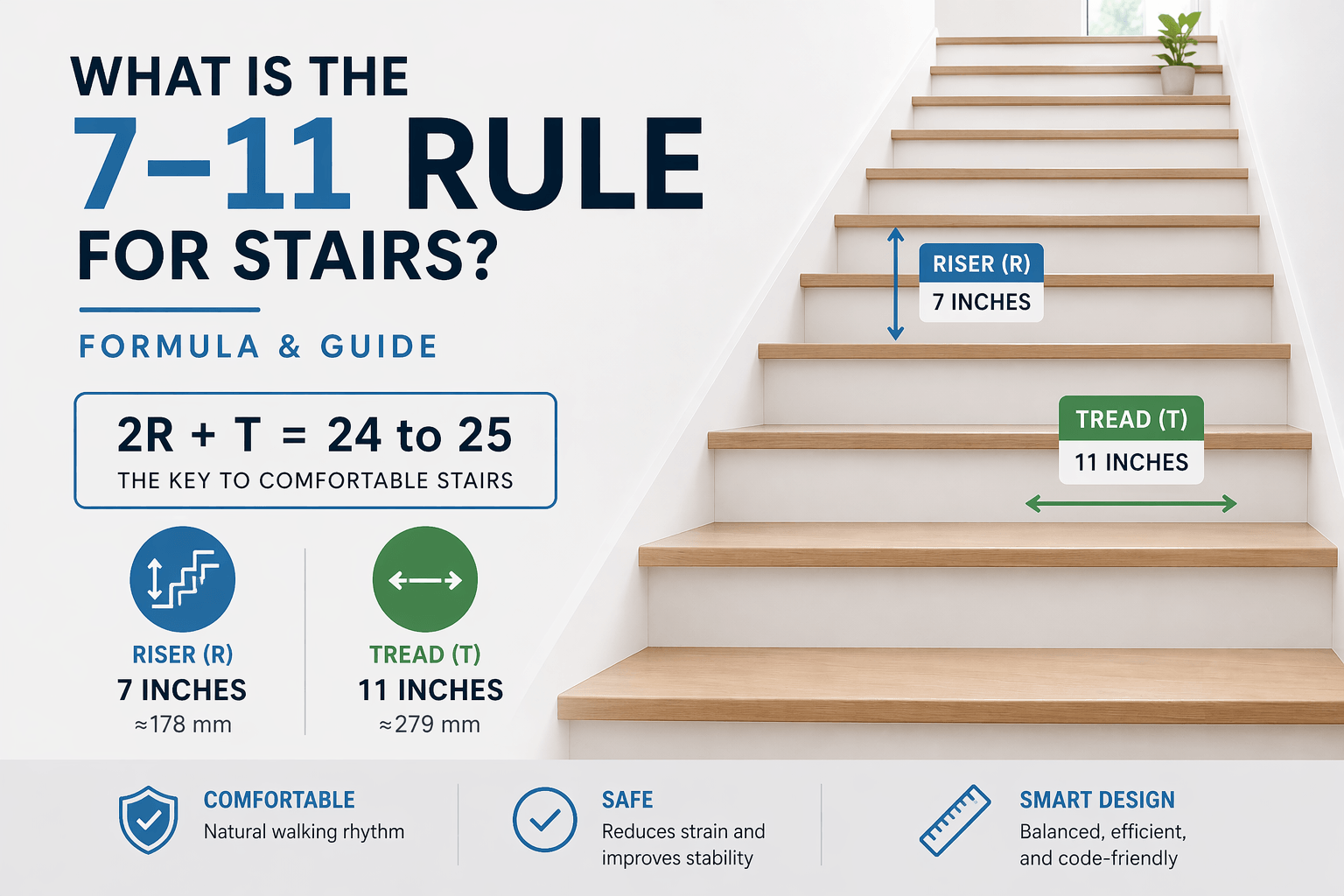
The 7–11 rule for stairs is one of the most commonly used guidelines in staircase design. It helps builders, architects, and homeowners create stairs that feel comfortable, safe, and natural to walk on.
In simple terms, the rule suggests:
- 7 inches (≈178 mm) for the riser height
- 11 inches (≈279 mm) for the tread depth
This proportion is widely used in residential stair design because it closely matches the natural stride of an average human walking pace.
However, the rule is not a strict law—it is a comfort guideline based on ergonomics and traditional building practice.
🧠 Why the 7–11 Rule Exists
The main goal of the 7–11 rule is to make stairs feel natural to use. If stairs are too steep, they become tiring and unsafe. If they are too shallow, they waste space and disrupt walking rhythm.
Human movement studies show that people naturally prefer a consistent step pattern. The 7–11 ratio aligns with this natural movement, reducing strain on the legs and improving balance.
This concept is widely referenced in architectural engineering discussions such as those found in the Engineering Toolbox, which explains how stair proportions are linked to ergonomic efficiency.
🔧 The Formula Behind the 7–11 Rule
The 7–11 rule is actually derived from a more general stair comfort equation:
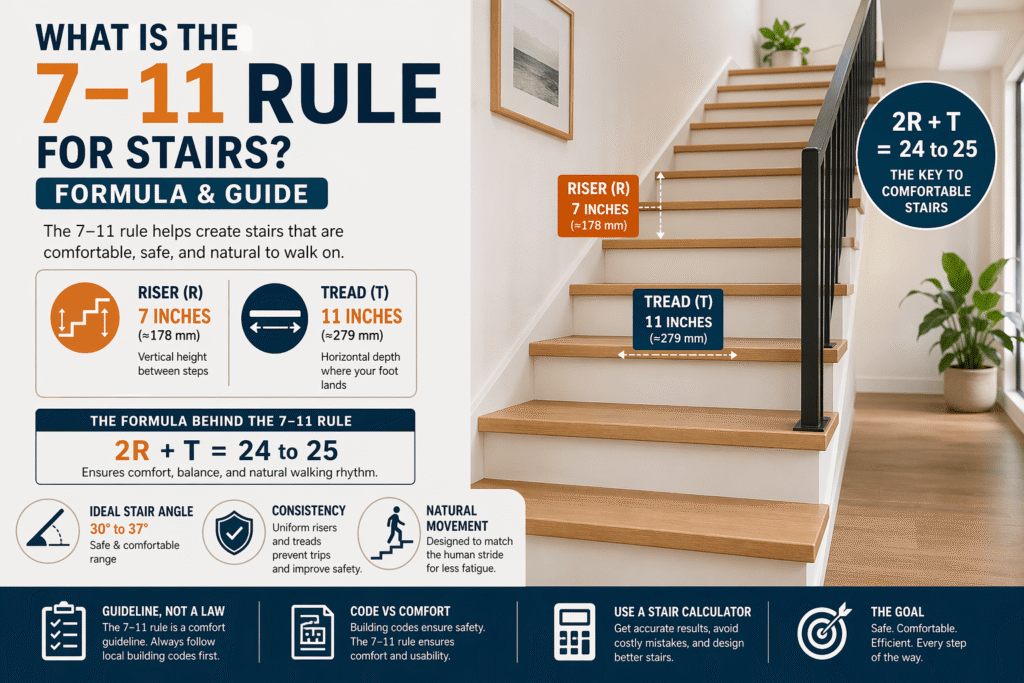
2R+T=24 to 25
Where:
- R = riser height (vertical step)
- T = tread depth (horizontal step)
✔ Why this formula matters:
- It ensures consistent energy use per step
- It maintains walking rhythm
- It reduces fatigue over long stair flights
✔ Example:
If:
- R = 7 inches
- T = 11 inches
Then:
- 2 × 7 + 11 = 25 → perfect comfort range
This formula is often used in professional stair design references and is closely tied to standards discussed by the International Code Council, which defines stair safety limits in residential and commercial buildings.
🪜 What Is a Riser and a Tread?
To understand the 7–11 rule properly, you must understand the two key components of a stair:
🔹 Riser
The riser is the vertical height between one step and the next.
- Higher riser → steeper stairs
- Lower riser → easier climb
🔹 Tread
The tread is the horizontal surface where your foot lands.
- Wider tread → more stability
- Narrow tread → less foot space
Together, riser and tread define how comfortable a staircase feels.
📐 Ideal Stair Angle Based on the 7–11 Rule
One of the most important outcomes of the 7–11 rule is the resulting stair angle.
✔ Ideal range:
- 30° to 37°
Why this matters:
- Below 30° → stairs become too flat and space-consuming
- Above 37° → stairs become steep and unsafe
This is why most residential staircases naturally fall within this range when the 7–11 proportion is followed.
🧮 Practical Example of Stair Design
Let’s say you are designing a staircase for a house:
Given:
- Floor-to-floor height = 2800 mm
Step 1: Choose riser height
We select approximately:
- 175 mm (close to 7 inches)
Step 2: Calculate number of steps
- 2800 ÷ 175 = 16 steps
Step 3: Determine tread depth
- Use ~280 mm (≈11 inches)
Result:
- A comfortable, evenly spaced staircase
- Balanced walking rhythm
- Safe and efficient design
📏 Is the 7–11 Rule Always Exact?
No. The 7–11 rule is a guideline, not a strict engineering requirement.
✔ Acceptable ranges:
- Riser: 6–8 inches (150–200 mm)
- Tread: 10–12 inches (250–300 mm)
Factors that affect design:
- Available floor space
- Stair type (straight, L-shaped, U-shaped, spiral)
- Local building regulations
- Architectural style
Even small variations can significantly change comfort, so consistency is more important than exact numbers.
⚖️ 7–11 Rule vs Building Codes
It is important to understand that the 7–11 rule is not a legal requirement.
| 7–11 Rule | Building Codes |
|---|---|
| Comfort guideline | Legal requirement |
| Flexible dimensions | Strict limits |
| Based on human comfort | Based on safety standards |
Official codes published by organizations like the American Institute of Architects and international building authorities ensure stairs meet safety requirements.
👉 Always follow local building codes first, then optimize using the 7–11 rule for comfort.
🧠 Other Important Stair Design Rules
Professional staircase design does not rely on only one rule. Several principles work together:
1. The 2R + T Rule
This is the mathematical foundation behind stair comfort.
2. Uniform Step Rule
Every step must have the same height to prevent tripping hazards.
3. Stair Slope Rule
Ensures stair angle remains within a safe and usable range.
These rules are widely discussed in engineering resources like the Engineering Toolbox.
🧰 Why Using a Stair Calculator Is Better
Manual calculations can lead to:
- Uneven steps
- Incorrect riser height
- Poor tread spacing
That’s why professionals use digital tools.
👉 You can calculate everything instantly using the tools available at StaircaseCalculator.com
It helps you:
- Calculate risers and treads accurately
- Design U-shaped, L-shaped, and straight stairs
- Avoid costly construction mistakes
📊 Common Mistakes in Stair Design
Many DIY builders and even some contractors make mistakes such as:
- Unequal riser heights
- Too steep stair angles
- Ignoring tread depth
- Not following consistency rules
These mistakes can lead to unsafe stairs and poor usability.
❓ Frequently Asked Questions
What is the 7–11 rule for stairs?
It is a stair design guideline recommending a 7-inch riser and 11-inch tread for comfortable walking.
Is the 7–11 rule mandatory?
No, it is a guideline. Building codes define mandatory safety limits.
What is the formula behind the 7–11 rule?
It is based on:
- 2R + T = 24–25
What is the ideal stair angle?
Between 30° and 37° for safe and comfortable movement.
Why is consistency important in stairs?
Because uneven steps increase the risk of trips and falls.
🎯 Conclusion
The 7–11 rule for stairs is one of the most practical and widely used guidelines in staircase design. It ensures a balance between:
- Human comfort
- Structural efficiency
- Safe movement
While it is not a strict law, it remains a foundational principle in residential and architectural stair design.
When combined with proper engineering standards, accurate measurements, and digital calculation tools, it helps create staircases that are safe, functional, and comfortable for everyday use.